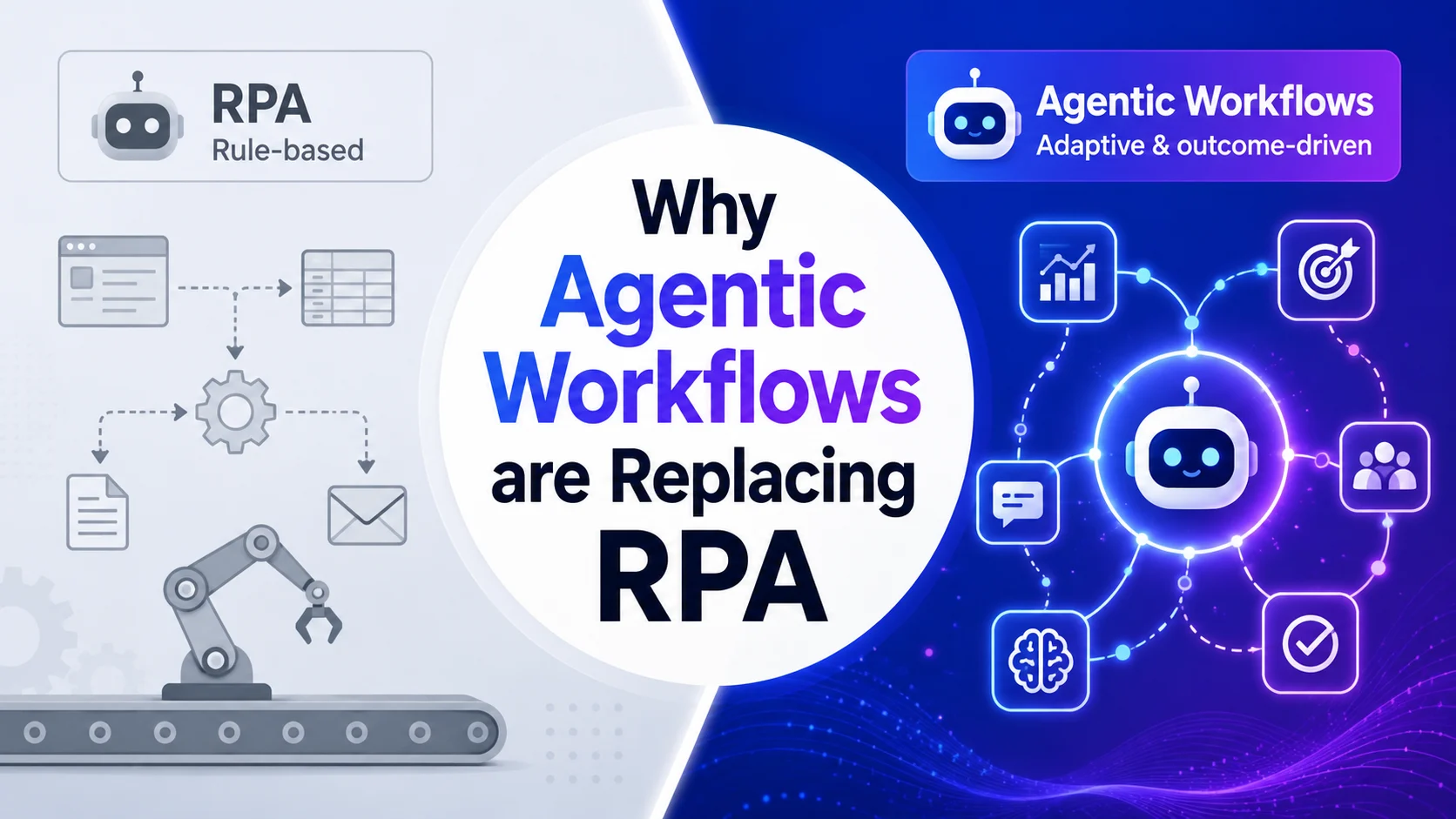
For the last decade, Robotic Process Automation (RPA) was the undisputed king of the enterprise. It promised to liberate humans from "drudge work" like data entry and form filling. And it worked, mostly. But as we move deeper into 2026, a quieter, more profound shift is happening.
The brittle, rule-based "bots" of the 2010s are being sidelined. In their place, Agentic Workflows, powered by Large Language Models (LLMs) and autonomous agents, are taking over.
At Traideas, we see this shift as the next stage of digital transformation: moving from software that stores information to systems that understand work, coordinate action, and help organizations operate smarter.
1. From "If-Then" to "Reason and Adapt"
The fundamental flaw of RPA is its brittleness. An RPA bot is essentially a high-speed macro. If a website updates its UI or an invoice format changes by a few pixels, the bot breaks. It follows a rigid "If-Then" logic that cannot handle the slightest deviation.
Agentic Workflows do not follow a script; they follow a goal.
- RPA: "Click button A, copy text B, paste to field C."
- Agentic AI: "Onboard this customer. Use whatever tools are necessary to verify their identity and update the CRM."
If the UI changes, the agent "sees" the new button and keeps going. It reasons through obstacles instead of throwing an error code.
2. Handling the "Messy Middle" (Unstructured Data)
RPA excels at structured data: spreadsheets and database fields. But roughly 80% of enterprise data is unstructured: emails, Slack messages, PDFs, and legal contracts.
Traditional RPA struggles here, often requiring expensive "Cognitive Document Processing" add-ons. Agentic workflows have LLMs at their core. They do not just scrape text; they understand intent. An agent can read a rambling client email, cross-reference it with a contract, and draft a resolution, all without a human defining a single rule for unhappy sentiment.
3. Tool Use vs. Screen Scraping
RPA often interacts with software by mimicking a human: moving a mouse, clicking buttons. It is slow and prone to failure.
Agentic workflows operate via Tool Use. Agents are designed to call APIs, query databases, and even run their own code to solve problems. Instead of pretending to be a human user, the agent acts as a dynamic orchestrator. It picks the right tool for the right moment.
4. The Maintenance Trap
The hidden cost of RPA has always been maintenance. Large companies often have entire teams dedicated just to fixing bots that broke because a software vendor pushed an update.
Agentic workflows are self-correcting. Because they use reasoning to navigate tasks, they do not need to be re-recorded every time a field moves. This shifts the ROI from "labor savings minus high maintenance" to "labor savings with near-zero maintenance."
5. Decision-Making Autonomy
RPA cannot make decisions; it can only follow a decision tree. If a bot encounters a scenario not covered by its 50 rules, it flags it for a human.
Agentic AI can be given bounded autonomy. You can set guardrails like: "You are authorized to issue refunds up to $50 if the customer has been with us for two years." The agent then evaluates the context and makes the call. It does not just move data; it moves the business forward.
Summary: The New Automation Stack
| Feature | Traditional RPA | Agentic Workflows |
|---|---|---|
| Core Logic | Deterministic (Rules) | Probabilistic (Reasoning) |
| Data Type | Structured (Excel, DBs) | Unstructured (Email, Voice, Video) |
| Failure Mode | Breaks on Change | Adapts to Change |
| Interaction | Screen Scraping | API & Tool Invocation |
| Goal | Task Completion | Outcome Achievement |
The Takeaway: If your automation strategy is still focused on mapping out every single click a human makes, you are building a museum, not a modern workflow. The future belongs to agents that can think, plan, and execute.