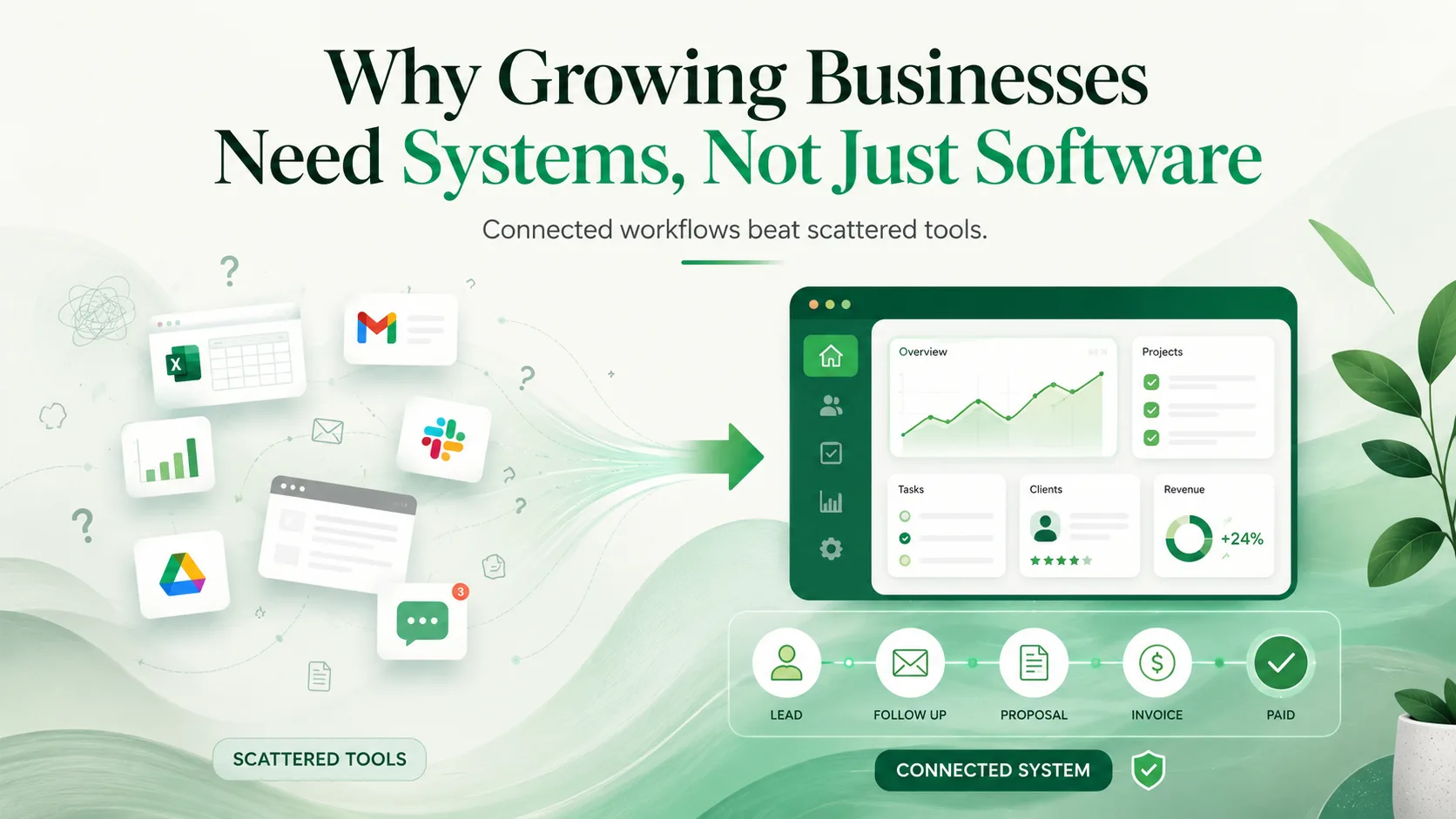
Most founders believe that as their company grows, they simply need more "tools." They buy a CRM to track leads, a project management tool to track tasks, and an accounting suite to track money. But a year later, they find their team is more overwhelmed than ever, spending half their day moving data from one solution to another.
The Takeaway: Most growing businesses do not need more features. They need better systems.
The Digital Paradox: Digitizing Forms vs. Workflows
The biggest mistake organizations make when scaling is digitizing forms instead of workflows.
When you digitize a form, you are just creating a digital version of a paper problem. You still have a silo of information that requires a human to manually push it to the next stage. When you digitize a workflow, you are building a system that understands the relationship between tasks, people, and outcomes.
The Takeaway: At Traideas, we see this shift as the next stage of digital transformation: moving from software that stores information to systems that understand work, coordinate action, and help organizations operate smarter.
1. Software is a Tool; a System is an Engine
Think of software like a hammer. It is useful, but it does not build a house by itself. A system is the blueprint and the construction crew combined.
- Software tells you what happened, for example: "A lead was created."
- Systems dictate what happens next, for example: "Since this lead is from the healthcare sector, assign it to the senior consultant and trigger the medical compliance checklist."
2. The Cost of "Feature Bloat"
Small businesses often get seduced by feature-heavy enterprise software. However, more features often lead to more complexity and lower adoption rates. A growing business needs scalable infrastructure, not a cluttered dashboard.
The goal should be a lean architecture where the software serves the process, not the other way around. If your team has to change how they work to fit the software, the software has already failed you.
3. Bridging the Silos
As a company grows, departments like Sales, Operations, and Finance naturally drift apart. Standard software often reinforces these silos because each team has its own source of truth.
A true systemic approach creates a unified workflow. It ensures that when a salesperson closes a deal, the operations team is automatically notified with the correct project specs, and the finance team has the invoice ready, without a single manual status update meeting.
4. Prepared for the Age of AI
We are entering an era where Agentic Workflows, AI agents that can reason and act, are replacing traditional automation. But an AI agent is only as good as the system it lives in.
If your business processes are a mess of uncoordinated tools, AI will only help you make mistakes faster. If you have a robust system, AI becomes the brain that orchestrates your growth, handling unstructured data and complex decision-making with ease.
How to Start Building Systems
If you feel like your business is drowning in software but starving for efficiency, it is time to audit your workflows:
- Identify the Dead Ends: Where does data go to sit manually until someone notices it?
- Map the Hand-offs: How does a project move from Sales to Delivery? Is it a push or a pull?
- Consolidate the Core: Instead of ten niche tools, can you build one integrated system that handles the 20% of tasks that drive 80% of your value?
Final Thought
Growth should not feel like a constant battle against your own tools. By focusing on high-level system architecture and scalable digital infrastructure, you stop managing software and start leading an organization.
The Takeaway: Build for the workflow you want, not the features you think you need.